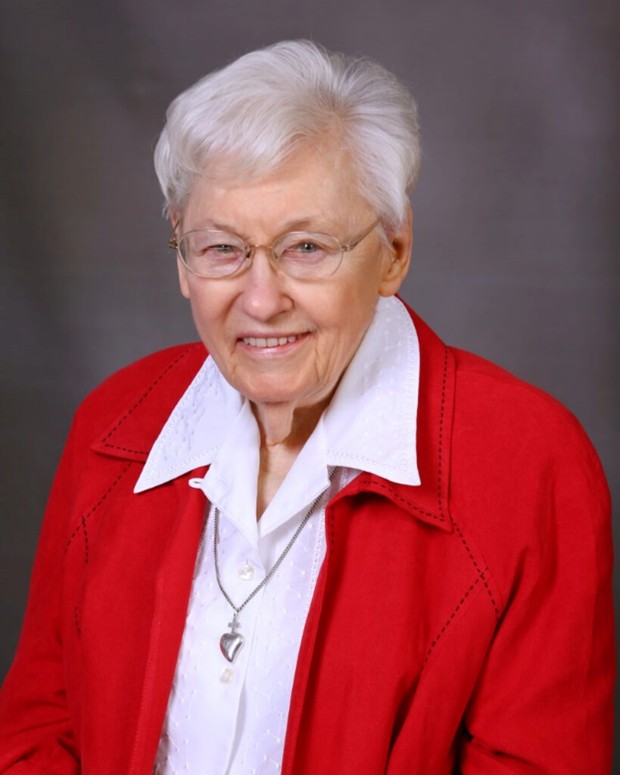
“You need a job, and we need a telephone operator,” explained Sister Elizabeth Kolmer shortly after I began my first year as a doctoral student at Saint Louis University. Sister had recruited me to the graduate program, serving as instructor in several of my courses and taking an interest in the lives of all her students. She lived one block away from campus in DeMattias Hall, a residence hall housing 130 sisters who ranged from graduate students from all over the globe to thirty retired sisters from Elizabeth’s own order, the Adorers of the Blood of Christ. “We had a big meeting, and while some were skeptical about having a man in the position, I told them you’d be a hoot!”
Sister Elizabeth was a well-regarded scholar at the university, and the sisters in the hall trusted her judgment as well. I learned of her stature from Sister Clotilda one day. “Elizabeth is the only one of us who gets two rooms,” she said excitedly, holding up two fingers to punctuate the point. “One to sleep in and one for her academics!”
In staffing the main desk of the hall, I also sorted mail and greeted visitors, and I also served as an ersatz counselor, a captive audience lending my ear and commentary to whomever lingered at the desk. That endeared me to many residents, and I learned so much more about their lives and vocations at regular meals held, as one elder sister told me, “in the refectory.”
“The what?” I asked.
“Oh,” she grinned, “the ‘cafeteria’ for the uninitiated!”
Sister Elizabeth shared her interest in researching the life of Mother Ann Lee, founder of the Shakers, and she encouraged me to learn more about the Hopedale Community in Massachusetts. Our research led us to an invitation to speak at a conference in Exeter, England. Neither of us had ever been, so with palpable excitement the student and the nun landed at Heathrow whereupon a police officer stopped us and asked, “What is the nature of your business?”Selected Essays
“Business!” Sister replied.
“Pleasure!” I chimed in.
We faced eight days of sightseeing and enjoying the academic conference, so after dropping our bags at the modest bed and breakfast, Sister turned to me and said, “I may never come here again, so let’s pack it in!” My 26-year-old self struggled to keep pace with her as we bounded from the British Museum to the Tower of London, “Richard the Third” in the West End to Westminster Abbey, and several other venues before we took the train to the University of Exeter to the conference. Out of my element, I followed Sister’s cue as we enjoyed drinks in the home of our British host. On hand was celebrated writer John Fowles, an Exeter resident. When I asked him what he was working on—my way of keeping up—he stammered, “I’m working on relearning half the words I’ve forgotten,” his wife adding that he was recovering, still, from a stroke. Horrified, I froze, but Sister rescued me with a hearty, “Um, let’s refresh that drink!” thereby saving her student.
After my graduation and throughout my 30-year-plus career in academia, I have kept in close contact with Sister Elizabeth who remains a constant source of support and inspiration. After retiring as a professor, she volunteered for several years in assisting Saint Louis’ homeless population, a vocation she regarded as a continuation of the lifelong religious vows she, her blood sister, and her cousin had taken in their teens so many years ago. When she was 80, I flew to Saint Louis and visited Sister Elizabeth at her rural Illinois convent where, despite physical infirmities and use of a walker, we laughed as she recalled clearly many moments we had shared decades ago. She no longer writes—Parkinson’s has seen to that—but once a year my phone rings and she announces herself with a soft but spirited, “Hellooo!” True to her professorial roots, she consults her notes and asks about my wife’s health and my children and their careers as a physician and a fencing coach. “I don’t get out much,” she tells me, “but it is so nice to talk on the phone with you again.” Indeed, Sister. Indeed.
 cgregoryphd.com